
Configuring and Editing the Results Email
The Results Email is the automatic email sent to each person who completes your scorecard. The email thanks them for participating and provides them with a copy of their results.
Configuring the results email:
To send a results email to quiz takers, follow these steps within the ScoreApp platform:
- Access Result Email Settings:
Ensure you have selected the Scorecard you wish to edit the result email for then navigate to the Settings -> Result Email section on the left nav.

- Toggle Result Email:
Switch on the "Result Email" option for automatic sending from the Score app platform. Toggle it off if you prefer sending results from your CRM.

- Choose Sender Email:
Select the sender address from where you want results sent. On the Starter Package the email will come from results@scoreappmail.com

- Send from a custom email address:
If you are on the Business Package and above you can choose a custom sender email address via the "accounts" and "domains settings" page in the dashboard.
Connect and verify your custom sender email address in the accounts and domains section. Then, return to results email settings show in step 3 to choose your preferred sender form the drop down option.

- Email Body Formatting:
Utilise the formatting toolbar to structure the email body.

Personalize content using merge fields. For instance, link the results page automatically through the result button or add a PDF report button if using PDF results.

Tip: It’s always a good idea to test your scorecard and you can do this by completing the scorecard yourself with a genuine email address in draft mode and checking the email you receive.
Sending a different results page in the results email
Normally every respondent lands on the same results page when they finish a scorecard, and that page is also what's linked from the results email.
Sometimes you want two versions instead: a lighter one they see straight after finishing, and a fuller one delivered only by email, for example a short summary on completion and a detailed breakdown by email, or simply two different versions for different purposes.
That needs two results pages in total: one set up as the page shown on completion, and a separate one whose link you build by hand into the results email.
How to build the link
The email link that points to a specific results page follows this pattern:
https://[your-scorecard-url]/results/{result_key}/[url-key-of-the-page]
Part What it is Where to find it your-scorecard-url Your scorecard's URL Shown in your account

{result_key} Merge tag that inserts the respondent's own result, so they see their own scores Type it manually, exactly as shown, curly brackets included

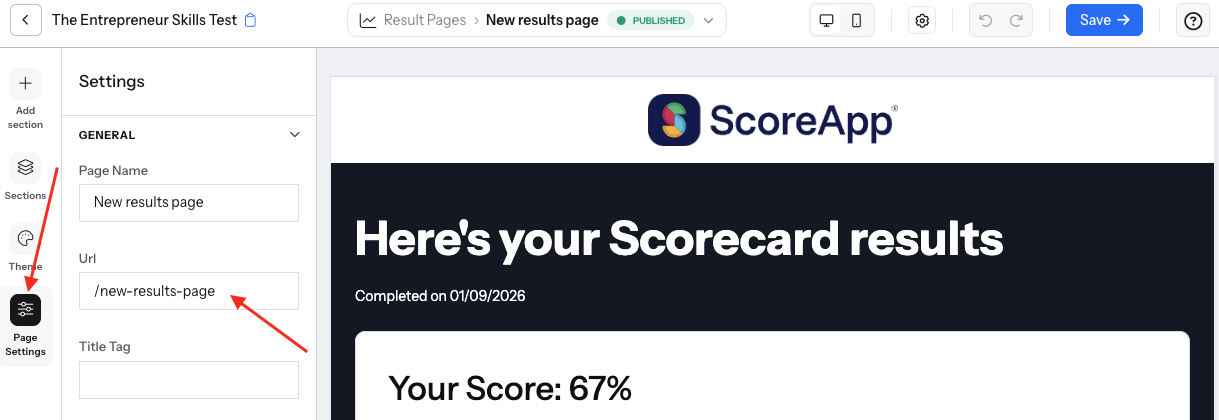
url-key-of-the-page The URL key of the page you want to deliver Open that results page → Page Settings → URL field
Example, scorecard at https://example-ab12cd34.scoreapp.com with URL key full-results:
https://example-ab12cd34.scoreapp.com/results/{result_key}/full-results
Steps
- Create your two results pages. Make the one respondents see at the end default, and publish the one you want to send in the email, but don't make it default.
- Find the URL key of the page you want to send by email. Open that second results page in the editor and click Page Settings, the URL field shows a URL key like
full-resultsormain-results-page-copy. You can grab it as is, or edit the field to whatever you'd prefer; either way, that's the URL key you'll use to build the link.
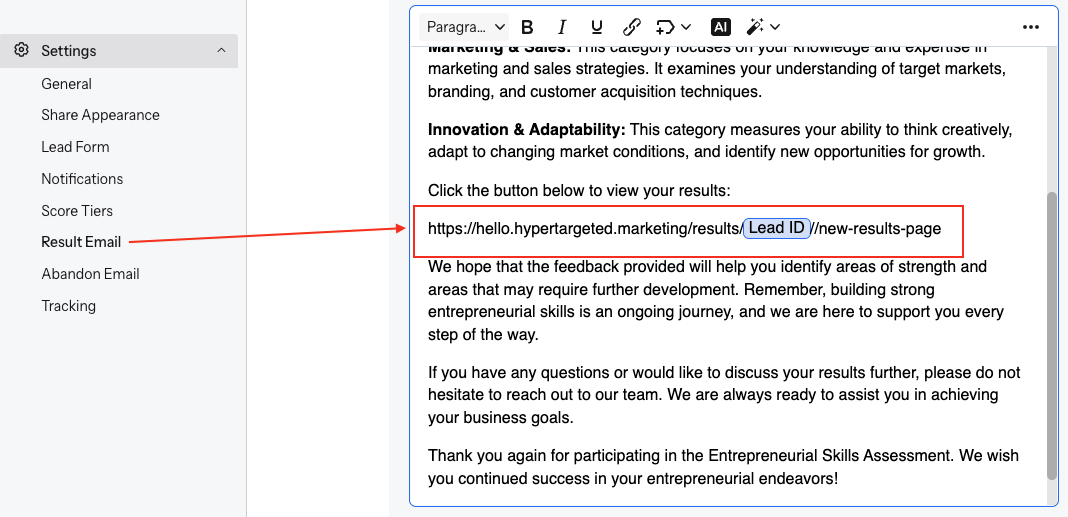
- Open your results email (Settings → Result email) and check the body. If it still has the default results-page button or merge tag, delete it, it links back to the completion page respondents have already seen, so it needs to come out.
- Build your link. Using the pattern above: your scorecard URL, then
/results/{result_key}/, then your URL key. Type{result_key}exactly as shown, curly brackets included — it's what fills in each respondent's own scores. - Add your new link where that button used to be. You can select some text, such as "View your full report", and turn it into a hyperlink, so respondents see the wording rather than the raw URL.
- Test it. Complete the scorecard yourself using an email address you can access. Confirm you land on the completion page, then open the email and check the link takes you to the other page, with your own scores on it.